

Graphic designers

Website designers
Mobile app developers
Software developers
3D artists

Illustration
Other popular skills
Featured jobs
Explore our current list of excited top featured projects.
Find contests
Unleash your talent and find freelancer contests to enter.

Website jobs

Graphic design jobs

Data entry jobs

Mobile app development jobs

Internet marketing jobs

Local jobs
Other popular jobs
Find work in different languages
Enterprise
Power your competitive advantage with Freelancer Enterprise.
Field Services
Deliver expertise anywhere in the world at scale - on demand.
AI for business
Let experts in the latest AI technology transform your business.

Freelancer products
Innovation Challenges
Turn challenges into breakthroughs with the largest innovation hub.
Freelancer API
Use the Freelancer API to access a cloud workforce of skilled freelancers.
Local jobs
Get help in any location, anywhere in the world.
Freelancer services
How it works

How to hire the perfect freelancer for your project
Get ideas

How to get started earning money freelancing
Resources


PRESENTS

POWERED BY

This challenge is now closed. To get a glimpse of the exciting event we had, we invite you to watch the video below!
Are you an innovator? Do you want to help public safety's ability to respond to emergency situations? This is the time to join!
The National Institute of Standards and Technology's Public Safety Communications Research (PSCR) Division is looking to create the future of incident command dashboards, including enhanced user interface/user experience (UI/UX) and the ability to convey situational data to enable better response to emergency situations. Powered by Freelancer.com and LMI, the CommanDING Tech Challenge is a four-phase challenge that includes laboratory testing and a live demonstration, giving you the opportunity to develop a state of the art incident command dashboard and compete for a share of the $1,000,000 USD prize purse. For existing solutions, the challenge will also allow you to receive feedback directly from public safety personnel, explore this new market opportunity and receive funding to improve your dashboard as you advance through each challenge phase.

Many incident command (IC) managers do not currently have access to technologies that present a real-time, holistic view of an emergency situation. While there are some existing tools and technology options, it does not address all the needs of public safety groups; some solutions are too costly, while others too cumbersome or difficult to use during an emergency scenario. As a result, many response teams still rely on paper and pens, large pieces of paper to map the area or whiteboards in their vehicles. This challenge seeks new and improved, interactive and intuitive dashboards that IC managers can trust in emergencies.

The $1,000,000 USD prize has been awarded! Congratulations to all winners of the First Responder Innovation Challenge.




In Phase 1 of the challenge, contestants must write a concept paper and provide images of their prototype describing their dashboard, detailing the improvements to be made in order to achieve the goals of the challenge. Up to 15 contestants will win awards and be invited to Phase 2a and Phase 2b of the challenge.

The invited Contestants will work with a public safety official to provide context for their prototypes. Contestants must submit a description of work signed by their Official Representative and their public safety partner. All Contestants whose submissions are accepted will be awarded an invitation to Phase 2b and $5,000 USD to support their collaboration with the public safety partner.
Contestants will document the progress they have made on their prototypes. Contestants will submit a written update and video demonstration of their prototype. In addition, the Judging Panel will have a short video conference with the Contestants to ask additional questions. Up to 8 Contestants will win awards and be invited to Phase 3 of the challenge.

For Phase 3, each contestant will be invited to a laboratory setting in Boulder, CO, where judges will test their dashboards running through an emergency scenario using simulated data. Up to 6 teams that are able to meet the minimum requirements will be awarded prize money, with the highest scoring team earning $100,000 USD.
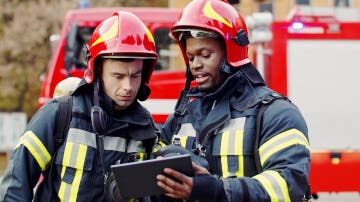
In Phase 4, the top 4 Contestants will demonstrate their dashboards to the judges and public safety community during a live event. Contestants will respond to a staged public safety emergency in a multi-story building. All 4 teams will win a cash prize, with first place earning $75,000 USD. In Phase 4, the judges may also award various Best-in-Class awards, each worth $10,000 USD.
Freelancer
About
Terms
Partners
Apps